
Open source PostgreSQL extensions
Postgres for Iceberg and data lakes
pg_lake lets you create and query Iceberg tables, and read and write Parquet, CSV and JSON files in object storage, all from PostgreSQL. Queries run on DuckDB's columnar engine, with full transactional guarantees and no SQL limitations.
A quick look
pg_lake turns PostgreSQL into a lakehouse. Add USING iceberg to CREATE TABLE and you get a transactional table whose data is stored as Parquet files in your object storage bucket, in the open Iceberg format that Spark, DuckDB and Snowflake can read too. The same extensions let you query raw Parquet, CSV and JSON files where they are, and COPY to and from URLs. Everything is plain SQL from psql or any PostgreSQL client, and the heavy lifting runs on DuckDB.
Create an Iceberg table. load_from creates the table from a file and loads it in one step, here a public file with 3 million New York taxi trips. Analytical queries run on DuckDB’s columnar engine:
CREATE TABLE trips () USING iceberg
  WITH (load_from = 'https://d37ci6vzurychx.cloudfront.net/trip-data/yellow_tripdata_2024-01.parquet');

-- which hours have the best tips?
SELECT extract(hour FROM tpep_pickup_datetime) AS hour, count(*) AS trips,
       round(avg(tip_amount)::numeric, 2) AS avg_tip
FROM trips GROUP BY 1 ORDER BY avg_tip DESC LIMIT 3;

 hour | trips  | avg_tip
------+--------+---------
    5 |  18764 |    3.82
   16 | 190201 |    3.68
   22 | 143261 |    3.56
Change it like any other table. Iceberg tables support INSERT, UPDATE, DELETE, MERGE and transactions, and pg_lake compacts the files and expires old snapshots in the background:
BEGIN;
DELETE FROM trips WHERE total_amount < 0;
UPDATE trips SET passenger_count = 1 WHERE passenger_count = 0;
COMMIT;
Move old rows out of PostgreSQL. Regular tables and Iceberg tables can be used in the same statement, so moving rows from an orders table to cheaper storage happens in one transaction, without losing or duplicating any:
CREATE TABLE orders_history (LIKE orders) USING iceberg;

WITH moved AS (
  DELETE FROM orders WHERE order_date < '2026-01-01' RETURNING *
)
INSERT INTO orders_history SELECT * FROM moved;
Read the tables from other engines. pg_lake writes standard Iceberg metadata, so Spark, pyiceberg, DuckDB and Snowflake can read the same tables, through PostgreSQL as the catalog or from the metadata file:
SELECT table_name, metadata_location FROM iceberg_tables;
Query files where they are. A foreign table reads Parquet, CSV or JSON files in place, including every file that matches a wildcard. Leave the column list empty to infer the columns:
CREATE FOREIGN TABLE clicks () SERVER pg_lake
  OPTIONS (path 's3://mybucket/clicks/2026/*/*.parquet');

SELECT page, count(*) FROM clicks GROUP BY page ORDER BY 2 DESC LIMIT 10;
Load new files as they arrive. With pg_incremental, a pipeline loads every file that is already in a bucket into an Iceberg table, then each new one exactly once:
CREATE FOREIGN TABLE order_files () SERVER pg_lake
  OPTIONS (path 's3://mybucket/inbox/*.csv', filename 'true');

SELECT incremental.create_file_list_pipeline('import-orders',
  file_pattern := 's3://mybucket/inbox/*.csv',
  batched := true,
  command := $$
    INSERT INTO orders_history SELECT order_id, order_date, amount
    FROM order_files WHERE _filename = any($1)
  $$);
Export a report. COPY ... TO writes any query result to object storage as Parquet, CSV or JSON:
COPY (SELECT tpep_pickup_datetime::date AS day, count(*) AS trips FROM trips GROUP BY 1 ORDER BY 1)
TO 's3://mybucket/reports/trips_per_day.csv' WITH (header true);
What you can do
USING iceberg, with hidden partitioning and automatic maintenance. Query data lake files Query Parquet, CSV, JSON and Iceberg files in object storage or at public URLs, with wildcards and inferred schemas. Import and export Load data from object storage and write query results back out with COPY, in any supported format. Interoperability Share tables with Snowflake, Spark and pyiceberg through PostgreSQL's catalog or an Iceberg REST catalog. Geospatial Query GeoParquet, Shapefiles, GeoJSON and more with PostGIS, store geometry in Iceberg, and push spatial filters down to DuckDB. Performance See what runs on DuckDB, how files are skipped and cached, and how to keep writes fast. Use cases
How it works
A pg_lake instance has two parts: PostgreSQL with the pg_lake extensions, and pgduck_server. You only ever connect to PostgreSQL. The extensions handle query planning, transaction boundaries and the Iceberg catalog, and delegate scanning and computation to pgduck_server, a separate multi-threaded process that runs DuckDB behind the PostgreSQL wire protocol.
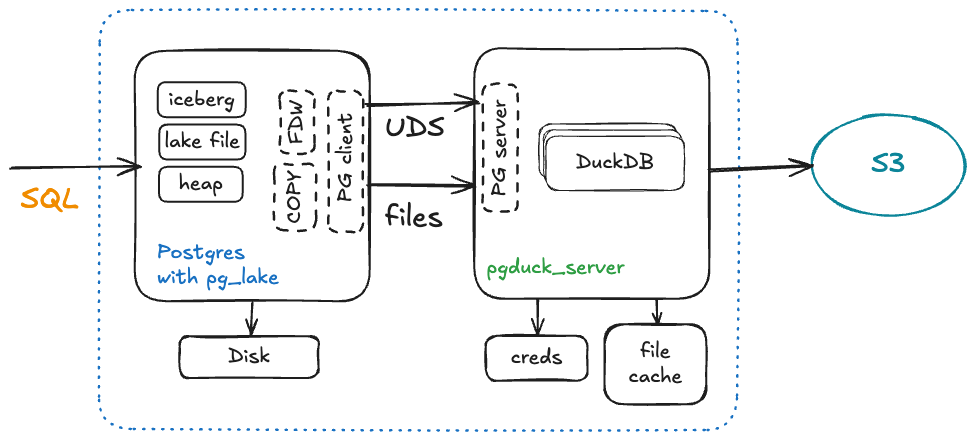
Running DuckDB in its own process avoids the threading and memory-safety problems of embedding it in PostgreSQL’s process-per-connection model, and lets you connect to the query engine directly with any Postgres client. How pg_lake works describes the components, the kinds of tables, and what happens when you query and write.